

On September 8, 2026, Mexico’s Department of Energy (“SENER”) published in the Official Journal of the Federation a resolution amending the Guidelines for the voluntary and expedited migration from self-supply and cogeneration of electricity to the provisions set forth in the Electricity Sector Law (the “Guidelines”), which were originally published on June 18, 2026.
As far as end users and their load centers are concerned, such amendments extend the timeline for expressing interest and requesting exclusion from legacy permits and contracts, as well as their migration to basic or qualified supply, while adjusting various applicable requirements of the migration procedures.
New Dates for Migration of Load Centers.
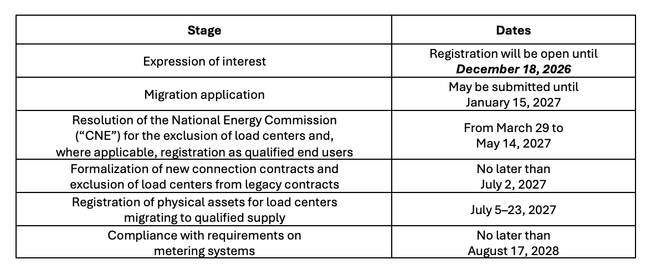
The Guidelines allow load centers to be excluded from a legacy scheme without requiring the power plant or other load centers to migrate simultaneously. For end users who choose this option, the recent amending resolution extended the key dates on the timeline, as follows:
Adjustments to Requirements.
When submitting the application, it will no longer be necessary to have a signed contract with the market participant who will represent the load center.
Instead, a letter of intent signed by the parties may be submitted, or at least, the supplier with whom the contractual relationship will be formalized must be identified.
The amendments to the Guidelines also provide flexibility regarding existing metering systems, allowing certain load centers to continue using their current equipment, subject to compliance with applicable technical requirements.
Furthermore, specific rules are established for the migration of load centers connected to shared substations, including requirements for individual metering.
New Transmission Methodology and Its Transitional Regime.
Also on June 18, 2026, the CNE published a new methodology for determining transmission service charges applicable to permit holders with power plants that have interconnection contracts and transmission agreements entered under the Electricity Public Service Law (the “Transmission Methodology”), which was modified on September 30, 2026.
The Transmission Methodology takes effect on October 19, 2026, and generally supersedes the provisions and methodologies previously applicable to the determination of these charges. In practical terms, the new methodology establishes a deadline for the application of “postage stamp” transmission rates, commonly known as “green wheeling”.
This change may have significant economic consequences for end users who receive energy under legacy arrangements. Although transmission charges are the responsibility of the permit holder, contracts with consuming partners typically allow for their full or partial pass-through. Therefore, the impact on each end user will depend on the terms of their respective contract.
The Transmission Methodology establishes a transitional regime under which certain permit holders may temporarily continue under the previous methodology provided that, among other requirements, their legacy contracts remain in effect beyond October 6, 2028, and they begin their migration under the Guidelines in a timely manner. In any case, this regime may not be extended beyond such date.
Implications and Next Steps.
For end users, the extension of the migration timeline should be analyzed considering the Transmission Methodology’s entry into force and the temporary nature of its transitional rules. Given the regulatory changes, it is advisable to review, starting now, the contracts governing their participation in legacy self-supply or cogeneration schemes, particularly the clauses regarding transmission charges, regulated costs, pass-through, changes in law, price adjustment mechanisms, and termination.
This involves reviewing the terms of interconnection contracts and transmission agreements, understanding the permit holder’s migration strategy, and quantifying the potential economic impact of the new methodology while the load center remains under the legacy regime.
In this scenario, it is important to define a transition strategy and evaluate electricity procurement alternatives for each load center, including, as appropriate, basic supply or qualified supply. This will enable the end user to identify and implement in a timely manner the actions required for migration.
* * *
At CCN, we have extensive experience advising end users on the various electricity procurement options available under the Mexican legal framework. Our team can assist in evaluating the implications of the recent regulatory changes, as well as in designing and implementing the strategy to be followed by each load center.